She Walks in Beauty
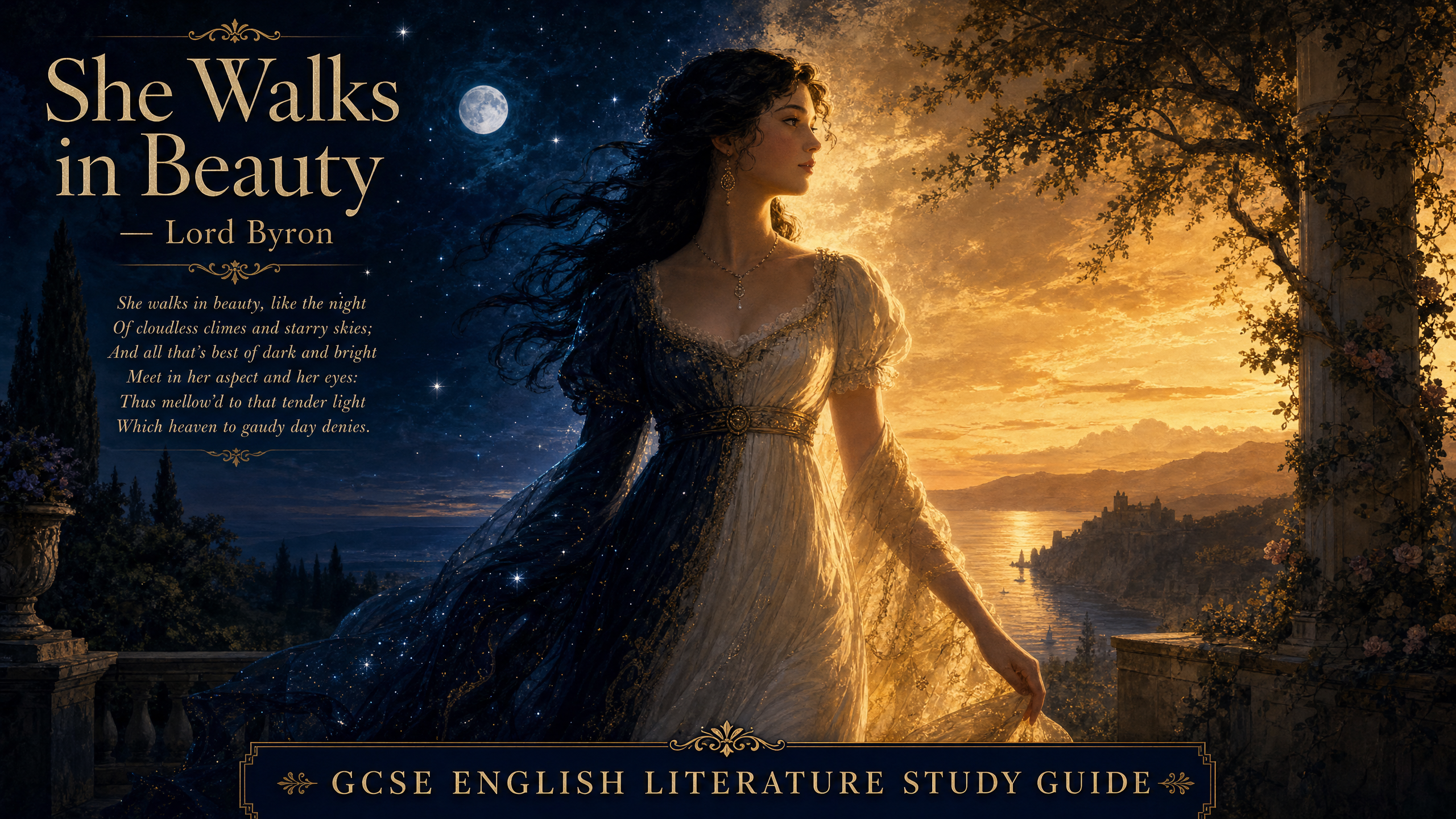
Lord Byron's 'She Walks in Beauty' is a masterpiece of Romantic poetry that explores the perfect harmony between physical appearance and moral goodness. Studying this poem allows candidates to demonstrate sophisticated analysis of structure and imagery, exploring how Byron uses the contrast of light and dark to celebrate an idealised vision of femininity.
Study Notes
Overview
Lord Byron's 'She Walks in Beauty' (1814) is a lyrical celebration of a woman whose extraordinary physical beauty is the outward expression of her inner virtue. Unlike many love poems that focus solely on appearance or use the sun as a metaphor for radiance, Byron compares his subject to a 'cloudless' night sky, establishing a central theme of harmonious opposites. For GCSE Literature candidates, this poem offers rich opportunities to analyse the synthesis of light and dark imagery, the disciplined use of iambic tetrameter, and the poem's structural progression from external observation to moral judgement. Examiners consistently reward responses that recognise this shift from the physical to the spiritual in the final stanza, and those that connect the poem's elevation of emotion and natural beauty to its Romantic context.
Podcast Revision
Listen to our comprehensive 14-minute revision podcast covering themes, context, and exam strategy:
Content Overview
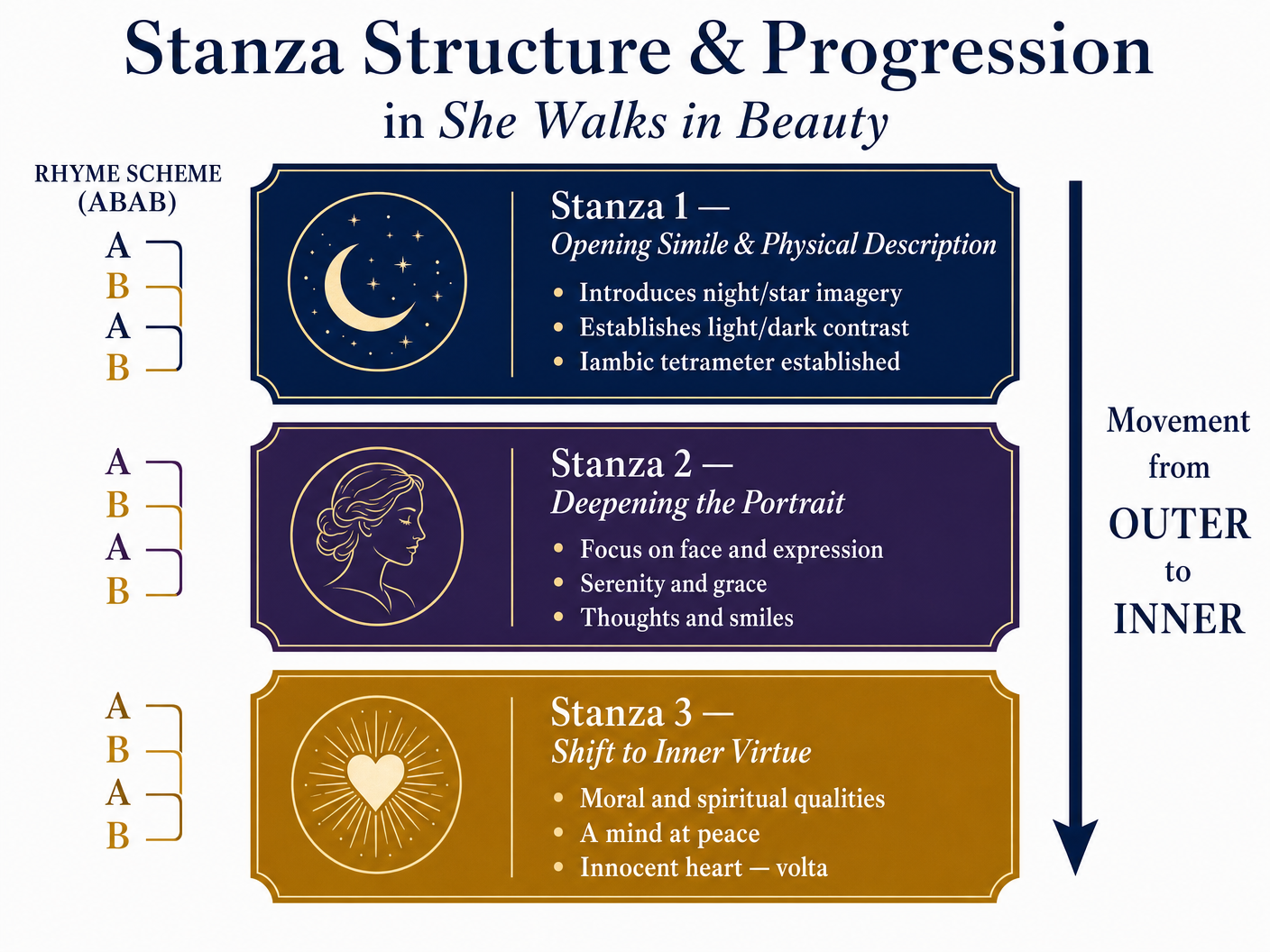
Stanza 1: The speaker introduces the woman, comparing her beauty to a clear, starry night. He establishes that her beauty is a perfect balance of 'dark and bright', creating a 'tender light' that is superior to the harshness of the day.
Stanza 2: The focus narrows to her face. The speaker notes that her beauty is so perfectly balanced that even the slightest alteration ('One shade the more, one ray the less') would ruin her 'nameless grace'. He observes her expressions, which suggest a serene and pure mind.
Stanza 3: The poem shifts entirely to her inner qualities. Her soft, calm features are read as evidence of a life spent in goodness. The speaker concludes that she possesses a peaceful mind and an innocent heart.
Themes
Theme 1: The Harmony of Opposites (Light and Dark)
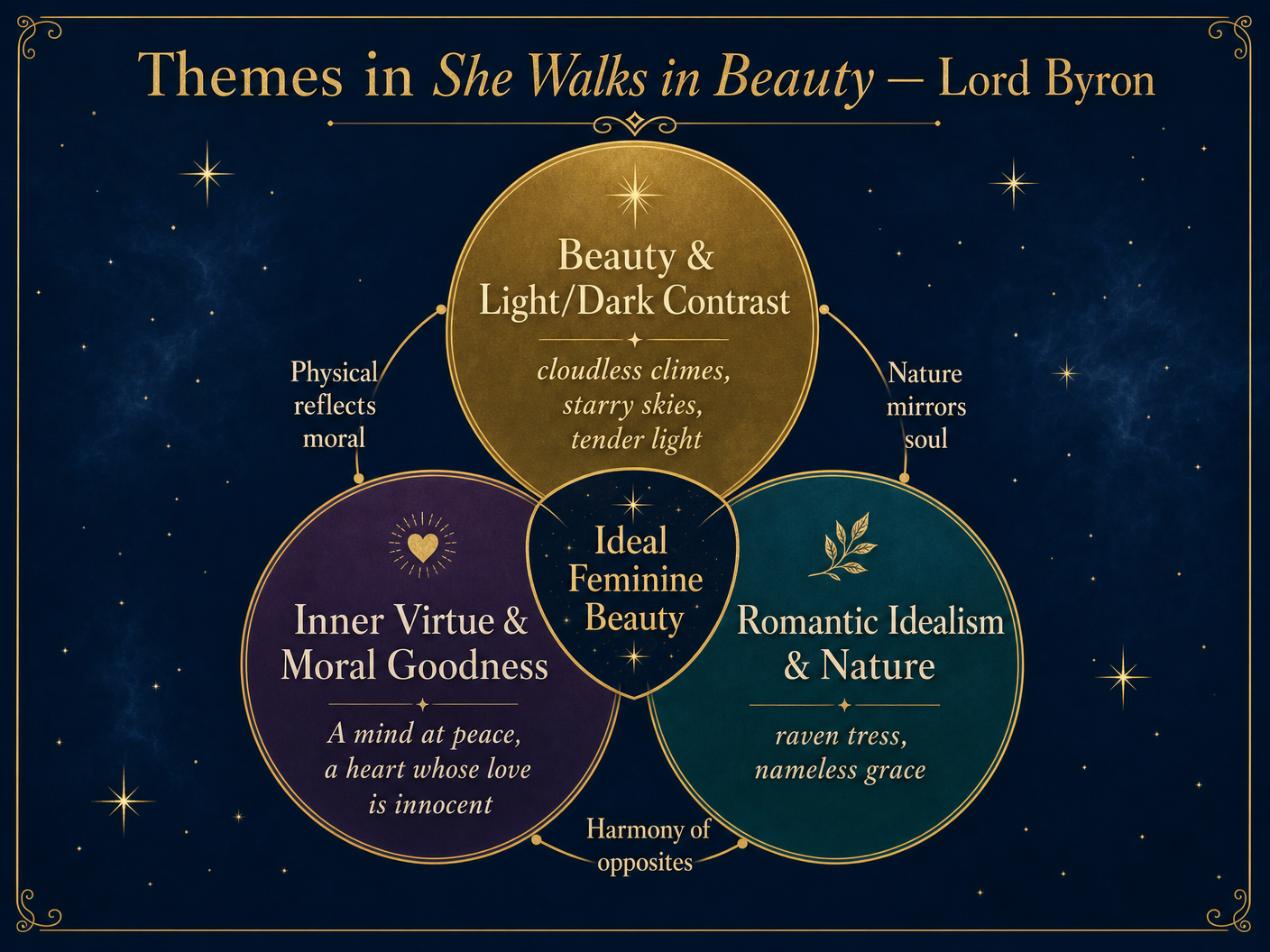
Byron uses the contrast between light and dark not to suggest conflict, but to illustrate perfect balance. The woman's beauty exists in the synthesis of these two forces.
Key Quotes:
- "like the night / Of cloudless climes and starry skies" (Stanza 1) - The simile subverts the expectation of comparing beauty to daylight, suggesting a beauty that is profound, vast, and clear.
- "And all that's best of dark and bright / Meet in her aspect and her eyes" (Stanza 1) - The verb 'meet' emphasizes harmony. She is not defined by one extreme, but by the perfect blending of both.
- "Thus mellow'd to that tender light / Which heaven to gaudy day denies" (Stanza 1) - The adjective 'gaudy' criticizes the harshness of daylight, elevating the subtle, refined 'tender light' of the night.
Theme 2: Inner Virtue and Outer Beauty
The poem structurally enacts a journey from admiring the woman's physical form to venerating her moral character. Byron argues that true beauty is the outward manifestation of inner goodness.
Key Quotes:
- "Where thoughts serenely sweet express / How pure, how dear their dwelling-place." (Stanza 2) - Her face ('dwelling-place') is beautiful because of the pure thoughts it houses.
- "The smiles that win, the tints that glow, / But tell of days in goodness spent" (Stanza 3) - Her physical attractiveness ('smiles', 'tints') serves merely as evidence ('tell of') her moral virtue.
- "A mind at peace with all below, / A heart whose love is innocent!" (Stanza 3) - The poem culminates not on a physical detail, but on her spiritual perfection.
Theme 3: Romantic Idealism
As a Romantic poet, Byron elevates emotion, nature, and individual experience. The woman in the poem represents an unattainable, idealized perfection.
Key Quotes:
- "nameless grace" (Stanza 2) - Suggests her beauty transcends language; it is sublime and cannot be fully articulated.
- "Which waves in every raven tress, / Or softly lightens o'er her face" (Stanza 2) - The connection between her physical features and the natural imagery of light reinforces the Romantic veneration of nature.
Writer's Methods
Form and Meter
Byron employs iambic tetrameter (four iambic feet per line: da-DUM da-DUM da-DUM da-DUM). This regular, rhythmic heartbeat mirrors the harmony and faultless perfection of the woman he is describing. The consistent ABABAB rhyme scheme in each stanza further reinforces this sense of order, balance, and completeness.
Structure
The poem is structured in three equal stanzas of six lines each (sestets). This reflects a logical progression: Stanza 1 focuses on the overall visual impression; Stanza 2 focuses on the details of her face; Stanza 3 shifts entirely to her internal, moral qualities. This movement from the external to the internal is the core structural method Byron uses to convey his message.
Language and Imagery
Byron relies heavily on antithesis (the juxtaposition of contrasting ideas). The continuous interplay of 'dark and bright', 'raven tress' and 'lightens', creates a chiaroscuro effect. His diction is elevated and semantic fields of purity ('cloudless', 'pure', 'goodness', 'peace', 'innocent') dominate the final two stanzas.
Context
- Biographical Context: Byron wrote the poem in 1814 after seeing his cousin by marriage, Mrs. Robert John Wilmot, at a party. She was in mourning, wearing a black dress with spangles, which inspired the imagery of the starry night sky. This spontaneous composition reflects the Romantic emphasis on immediate emotional response.
- The Romantic Movement: Flourishing in the late 18th and early 19th centuries, Romanticism prioritized emotion over reason, celebrated nature, and often focused on the sublime. Byron's elevation of this woman to an almost divine status aligns with these ideals.
- Alternative Interpretations: A feminist reading might critique the poem for objectifying the woman. She is entirely silent and passive, existing only to be observed and idealized by the male speaker. While Byron praises her 'mind' and 'heart', he does so without allowing her any agency.
Worked Examples
1 detailed example with solutions and examiner commentary
Practice Questions
Test your understanding — click to reveal model answers
Explore how Byron presents the relationship between physical appearance and inner character in 'She Walks in Beauty'.
Hint: Track the progression of the poem. Start with the physical descriptions in stanzas 1 and 2, and then focus heavily on how stanza 3 reinterprets this physical beauty as evidence of moral goodness.
How does Byron use natural imagery to convey his admiration for the woman in 'She Walks in Beauty'?
Hint: Focus on the opening simile, the rejection of 'gaudy day', and how the vastness of the night sky elevates the woman's status.
Read the following extract (Stanza 1). How does Byron use language and structure to create an immediate impression of the woman?
Hint: Focus heavily on AO2. Look at the contrast between 'dark and bright', the rhythm of the lines, and the effect of the word 'mellow'd'.
Evaluate the view that 'She Walks in Beauty' is more about the speaker's own ideals than it is about a real woman.
Hint: This requires a critical, evaluative approach. Consider how the woman is silenced, how her beauty is elevated to the 'sublime', and how this reflects Romantic masculine perspectives.